
Microsoft Artificial Intelligence (AI)
Why a 360° Customer View Is Now a Business Imperative
Learn how Microsoft Fabric and Purview enable a secure, scalable 360° customer view that improves customer experiences and business performance.
Welcome to Silicon Overdrive!

Home » Microsoft » Microsoft Artificial Intelligence (AI) » AI, Data Privacy, and the Risk of the Overshare: Staying Safe in the Age of Generative AI
Artificial intelligence (AI) is transforming how businesses operate. Tools like ChatGPT and Gemini are now household names for productivity, brainstorming, and insight generation. However, the convenience of public AI tools can come with serious data security implications for organizations.
When employees upload confidential information to unsecured AI systems, they expose their company to AI data privacy risks, compliance violations under frameworks such as the General Data Protection Regulation (GDPR) and the Protection of Personal Information Act (POPIA), and the hidden threat of shadow AI.
In this article, we will explore why public AI use in the workplace can be risky, examine compliance and governance challenges, and outline practical steps for secure, enterprise‑grade AI adoption. We will also look at how Microsoft is addressing these concerns through responsible AI principles and solutions like Microsoft Copilot for Microsoft 365.
Public AI tools like ChatGPT offer fast, intuitive access to generative AI capabilities. Employees can ask questions, generate drafts, summarise documents, and more. In many cases, these tools are free or inexpensive. That ease of use drives adoption even without IT approval.
However, most public AI services are not designed for handling sensitive business data. They often process inputs on shared infrastructure, use the data to improve their models, or store queries in a way that is not transparent to the end user.
This raises significant concerns:
When employees paste proprietary contracts, internal strategy documents, or customer details into a public AI chat, that information may be stored or used to train models outside of the organization’s control. That can mean unauthorised replication of trade secrets and loss of competitive advantage.
Further, even if the AI provider claims not to retain data, there is rarely a clear, enforceable guarantee in enterprise contracts for free or consumer offerings.

Most public AI tools are hosted by companies that operate globally. This means data crossing international borders and being processed in jurisdictions with different privacy protections.
For organizations bound by laws like GDPR in the European Union or POPIA in South Africa, this can create compliance challenges:
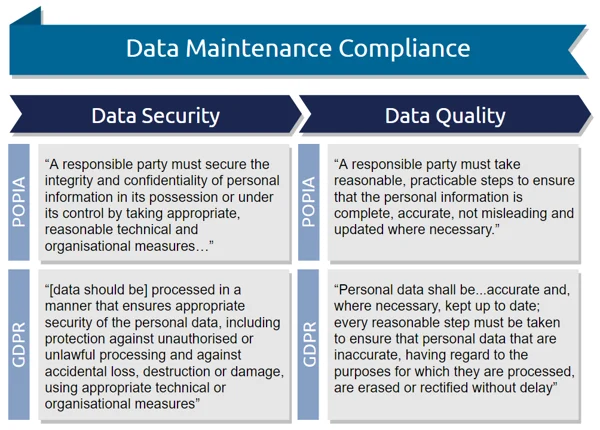
Uploading personal or sensitive information into a public AI model without proper safeguards can violate these requirements and result in regulatory penalties, reputational harm, and loss of customer trust.
One of the most overlooked risks of AI adoption is shadow AI. This term refers to the unapproved use of AI tools by employees to get work done. Shadow AI often happens outside IT’s knowledge or control, because it feels faster or easier than going through formal channels.
Shadow AI creates multiple risks:
Security teams may have no insight into how frequently sensitive corporate data is being shared with public AI services. This lack of oversight makes risk management and incident response far more difficult.
GDPR applies to any organization that processes the personal data of EU citizens, regardless of where the organization is based. It enforces requirements on:
Using AI tools that transfer data to servers outside GDPR‑protected environments without proper safeguards can violate these principles. Organizations must evaluate where AI requests are processed and ensure contractual protections with vendors.
The Protection of Personal Information Act (POPIA) sets similar expectations for organizations handling personal information in South Africa.
It requires:
If an employee uploads a customer’s contact details or financial record into a public AI chat, the organization could be held responsible under POPIA for failing to protect that information.
In both the GDPR and POPIA contexts, an enterprise must know where data flows, how it is processed, and who has access to it. Public AI tools that process data in unpredictable ways make this difficult.
Organizations need clear strategies for adopting AI responsibly. Treat AI tools as they would any critical IT system.
Here are practical steps to enhance data protection and operational security:
Develop policies that:
Make sure employees understand the rationale. Treat AI policies with the same weight as email, cloud storage, or endpoint security policies.
Security awareness training should include:
Training empowers employees to be part of the company’s security posture rather than being inadvertent weak links.
Replace risky public AI usage with enterprise tools that provide:
An example is Microsoft Copilot for Microsoft 365.
Microsoft 365 Copilot uses Microsoft Graph under each user’s existing permissions and access controls. According to Microsoft, prompts, responses, and data accessed through Microsoft Graph are not used to train foundation LLMs used by Copilot. Copilot operates within the Microsoft 365 service boundary, and Microsoft provides data residency commitments for the content of interactions and related artifacts per the Product Terms.
Use DLP for Microsoft 365 Copilot and Copilot Chat to block prompts that contain sensitive information types (SITs) and to restrict Copilot from processing sensitivity‑labeled files/emails. These controls reduce oversharing and create auditable enforcement in your tenant.
Shadow AI thrives in areas with a productivity gap.
IT and security teams should:
Governance does not mean arbitrarily restricting access. It means enabling safe, productive use while protecting data.
AI technology and regulatory landscapes are evolving fast.
Regularly revisit:
This helps organizations stay ahead of emerging threats and maintain robust AI data privacy practices.
Custom GPTs give organizations a more controlled and secure way to use generative AI, reducing the risks associated with public, open-ended tools. Instead of employees interacting with general-purpose AI and potentially oversharing sensitive information, Custom GPTs can be purpose-built for specific business tasks, teams, or use cases, with clear guardrails in place.
These models can be configured with defined boundaries around behavior and data access. Organizations can restrict what information a Custom GPT can reference, control how it responds, and choose platforms that offer enterprise-grade data protections. Depending on the provider and plan, this can include ensuring that customer inputs and outputs are not used to train models by default, significantly lowering the risk of sensitive data being reused or exposed.
It is important to note that data handling varies by platform. For example, OpenAI’s Enterprise, Business, and API offerings do not use customer conversations for model training by default, as outlined in their enterprise data usage policy. Consumer AI tools may use interactions for model improvement unless users explicitly opt out.
Custom GPTs also support stronger governance. They can be aligned with POPIA or GDPR requirements, secured with role-based access controls, and audited to provide visibility into how AI is used across the organization. This level of oversight is often missing when teams rely on public AI tools.
Book a consultation to explore our Custom GPT offerings to safely unlock AI for your business.
Microsoft has been vocal about responsible AI and building enterprise solutions accordingly.
Their approach is anchored on principles like:
Solutions like Microsoft Copilot for Microsoft 365 are built with enterprise needs in mind. Copilot uses secure processing environments, respects data governance policies, and integrates with Microsoft’s compliance tools.
This gives organizations:
By working within existing governance frameworks, such tools help organizations benefit from generative AI while reducing uncontrolled data exposure and the risks associated with shadow AI.
Microsoft also publishes guidance on responsible AI use, including how organizations can mitigate bias, ensure security, and maintain data privacy. These resources help companies align technology adoption with ethical and legal responsibilities.
AI tools bring incredible potential for productivity and innovation. But without proper oversight, they can become a vector for data loss, compliance violations, and opacity in how information is used. Public AI tools like ChatGPT can be useful for general tasks, but they should never be a repository for sensitive enterprise data.
To protect organizational data and comply with regulations like GDPR and POPIA, companies need:
By embracing responsible AI principles and solutions such as Microsoft Copilot for Microsoft 365, organizations can enjoy the benefits of AI innovation while safeguarding their most valuable asset: their data.
Intentional, well-governed AI adoption shifts AI from a potential risk into a trusted driver of business value.
Talk to our Microsoft experts to explore responsible AI practices, robust data protection, and enterprise-grade solutions such as Microsoft Copilot.
Learn how Microsoft Fabric and Purview enable a secure, scalable 360° customer view that improves customer experiences and business performance.

Discover how SQL Server 2025 transforms data management with built-in AI, vector search, JSON support, and real-time analytics for modern businesses.

Modernize SQL workloads with Azure SQL Managed Instance. Boost scalability, security & performance with Silicon Overdrive’s cloud expertise.
We use cookies to track visitors, measure ads, ad campaign effectiveness and analyze site traffic. We may also share information about your use of our site with 3rd parties. For more info, see, our Cookies Policy, our Privacy Notice. By clicking “Accept All” you agree to the storing of all cookies on your device. In case you don’t choose one of these options and use our website, we will treat it as if you have accepted all cookies.
We use cookies to track visitors, measure ads, ad campaign effectiveness and analyze site traffic. We may also share information about your use of our site with 3rd parties. For more info, see, our Cookies Policy, our Privacy Notice. By clicking “Accept All” you agree to the storing of all cookies on your device. In case you don’t choose one of these options and use our website, we will treat it as if you have accepted all cookies.